Clements Center Completes Second Annual Korea May Term on U.S. Strategy and the Indo-Pacific
Jun 30, 2026
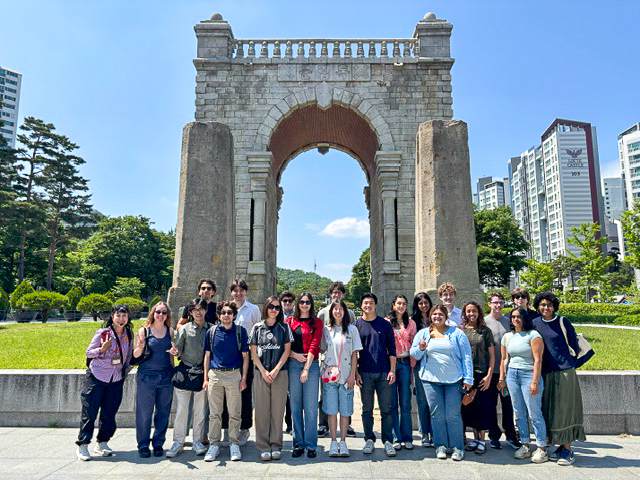
UT Austin students spent four weeks in South Korea and Japan tracing the history, alliances, and security challenges that define America’s role in the Indo-Pacific.
From the Asan Institute in Seoul to the cliffs of Okinawa and the Joint Security Area at Panmunjom, UT Austin students spent four weeks this spring studying the role of the United States in the Indo-Pacific. The program—America in the Pacific: American History, Strategy, and the Future of the Indo-Pacific Region—is built around a simple premise: U.S. interests in the Indo-Pacific are best understood in direct conversation with the allies who share the region. Much of the program centers on engaging South Korean practitioners, policymakers, and strategic thinkers about how they view their own place in the Indo-Pacific and their relationship with the United States.
Based in Seoul, the academic program examined the historical foundations and contemporary challenges of the U.S.–ROK alliance within the broader strategic landscape of the Indo-Pacific. Through lectures by leading scholars and practitioners, students explored South Korea’s democratization and economic transformation, the geopolitical evolution of the Korean Peninsula, relations between South Korea and Japan, and the enduring legacy of the Korean War. These themes were reinforced through site visits to Hiroshima, Okinawa, and the Korean Demilitarized Zone, allowing students to connect historical scholarship with the places that have shaped the region’s security architecture.
The curriculum also addressed the strategic challenges facing Northeast Asia today, including governance under the Kim family regime, South Korea’s response to North Korea’s nuclear program, China-DPRK relations, South Korean perspectives on Taiwan, and the implications of artificial intelligence and other emerging technologies for deterrence, nuclear strategy, and the future of warfare. As part of the program, students visited the Asan Institute for Policy Studies for seminars on South Korean democratization and Indo-Pacific alliances, engaging directly with one of the country’s leading foreign-policy think tanks.
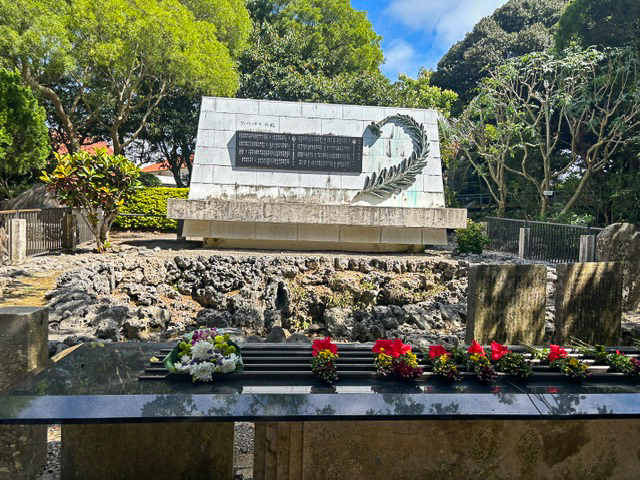
The Japan leg took students to two places where the Pacific War’s costs were most directly felt. In Hiroshima, the group visited the Peace Memorial Park and Museum and heard from Sachiko Hiraoka, an A-bomb Legacy Successor. At the Children’s Memorial and the Cenotaph for the Korean Atomic Bomb Victims, students presented in groups to familiarize their classmates to the historical significance of each site. Joined by Dr. Mark Lawrence, students also traveled to Okinawa, where they visited the Former Japanese Navy Underground Headquarters, the Okinawa Prefectural Peace Memorial Museum, the Himeyuri Peace Museum, Shuri Castle, and Hacksaw Ridge.
Returning to South Korea, students experienced the enduring realities of the U.S.–ROK alliance firsthand through a visit to the Demilitarized Zone, a tour of the Joint Security Area at Panmunjom, and lunch with U.S. soldiers at Camp Casey. The program convened in Ulsan with a visit to Hyundai Heavy Industries, where students saw how the alliance extends well beyond defense. Together, these experiences demonstrated that the partnership between the United States and South Korea is sustained not only through shared security commitments, but also through deep industrial, technological, and economic ties that continue to shape the Indo-Pacific region.
In Busan, students examined the lasting human legacy of the Korean War through visits that connected history, memory, and national identity. At Gamcheon Culture Village, a community established by refugees during the war, students considered the ways conflict continues to shape contemporary South Korea. They also visited Haedong Yonggungsa Temple, a Buddhist temple originally established in the fourteenth century, whose dramatic setting along Korea’s eastern coast offered a window into the cultural traditions that have endured through centuries of political and social change. The experience concluded at the United Nations Memorial Cemetery, where the graves of service members from 11 nations served as a powerful reminder of the international coalition that defended South Korea and the enduring legacy of the Korean War.
Alongside the field program, students engaged directly with leading scholars, policymakers, military officers, and practitioners from some of South Korea’s foremost academic and policy institutions, including Korea National Defense University, the RINSA Institute, the Asan Institute for Policy Studies, the Sejong Institute, Yonsei University, the Korea Institute for National Unification, the Unification Policy Research Division, and the Database Center for North Korean Human Rights. Students also participated in a candid discussion with a North Korean defector, offering a firsthand perspective on the human consequences of division and authoritarian rule. These engagements culminated in an evening hosted by former South Korean National Security Advisor Dr. Kim Sung-han, a UT Austin alumnus, whose reflections on South Korea’s foreign and security policy provided an exceptional capstone to the program’s academic experience.
Anya Patel, an international relations and global studies major, said the trip was unforgettable, both for what she saw and for the people she shared it with.
“A highlight was definitely visiting the demilitarized zone and seeing North Korean soldiers firsthand, as well as visiting Camp Casey, one of the American military bases in South Korea,” she said. “Getting to talk with the soldiers about their perspective on ROK–US military relations was a unique experience, and one that was really important for understanding the partnership. Participating alongside like-minded, dedicated students was also truly amazing. I’m so happy I had the opportunity to take part, and I’d recommend it to anyone interested in the region or in international policy in general.”
Check out the video recap and the photo album for a closer look at the 2026 Korea May Term.
Applications for the 2027 Korea May Term will open in September 2026. Students interested in the program can learn more on the Clements Center website.