

Between Israel and Iran: UT Experts and a Former Ambassador Evaluate the Middle East’s Next Phase
Oct 27, 2026

With Saudi oil facilities under attack and the status of Iran’s nuclear program uncertain, The University of Texas at Austin convened a special event featuring former Israeli Ambassador Michael Oren and a panel of our own scholars and practitioners to discuss where the region is headed. Between Israel and Iran: Security, Strategy, and the Future of the Middle East, drew students, faculty, alumni, and community members to the Etter-Harbin Alumni Center for a timely discussion of the region’s evolving security challenges and strategic landscape.
The Clements Center for National Security hosted the event with the Texas Holocaust, Genocide, and Antisemitism Advisory Commission, with support from the Strauss Center for International Security and Law, the Clements-Strauss Intelligence Studies Project, and the LBJ School of Public Affairs. The program paired a keynote discussion with Ambassador Michael Oren, Israel’s ambassador to the United States from 2009 to 2013, with an afternoon panel of UT faculty and former senior national security officials.
UT Executive Vice President and Provost William Inboden opened the keynote by noting that every president since Richard Nixon has taken office intending to reduce America’s role in the Middle East, and every one has found his presidency drawn back into the region. “America may not be interested in the Middle East,” Inboden said, paraphrasing Trotsky, “but the Middle East is interested in America.”
Lessons From Seven Decades of War
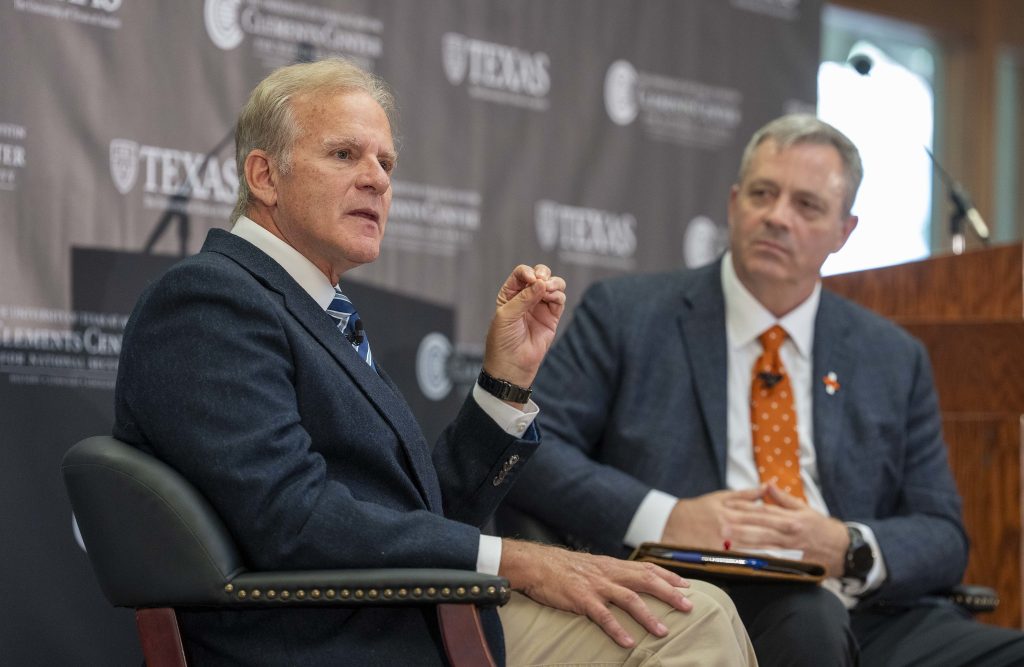
Oren, a historian and former member of the Knesset, answered questions from Clements Center Executive Director Paul Edgar. His central argument reached back to the 1956 Suez Crisis: in war after war, he said, the United States pressed Israel to stop before reaching a decisive result, for understandable reasons rooted in Cold War fears of escalation, but with the recurring effect of setting up the next conflict.
Applied to Iran, that history led him to urge policymakers to “set the goal of the war to win it and define what you mean by win it.” He named three measures of success: freedom of navigation and energy supply, an end to Iran’s nuclear program, and a halt to its support for terrorism. He also cautioned against assuming the aftermath would take care of itself, citing Iraq and the Arab Spring as examples of what follows when no alternative leadership is ready.
Oren outlined three gambles that Hamas leader Yahya Sinwar made on Oct. 7, 2023: that Israel would remain divided, that the Muslim world would join the attack, and that Western opinion would turn against Israel. Only the third, he said, paid off.
Advice for the Next Generation
Oren met with Clements Center undergraduate fellows over breakfast before the event, and much of the keynote spoke directly to students. He recalled deciding at 15 that he wanted to be Israel’s ambassador to the United States after shaking hands with the man who then held the job, Yitzhak Rabin, for whom he later worked as an adviser. He described the ambassadorship as “the second most difficult job in the world after being the prime minister of Israel.”
“If you don’t understand history,” he told students, “You are coming into any discussion at a disadvantage.” A career in public service means little sleep and a modest income, he said, but a life “totally suffused with meaning.”
One student asked how Israel plans to counter inexpensive long-range drones. Oren predicted that effective defenses would emerge, as they have for every previous weapon, and described the current period as a “drone interregnum” rather than a permanent shift. Another question concerned divisions inside Israel ahead of its elections. A visibly divided society is a strategic vulnerability, Oren said, and he called Israeli democracy “not a luxury” but the mechanism that lets a fractious country settle its arguments.
The View from Riyadh and Tehran
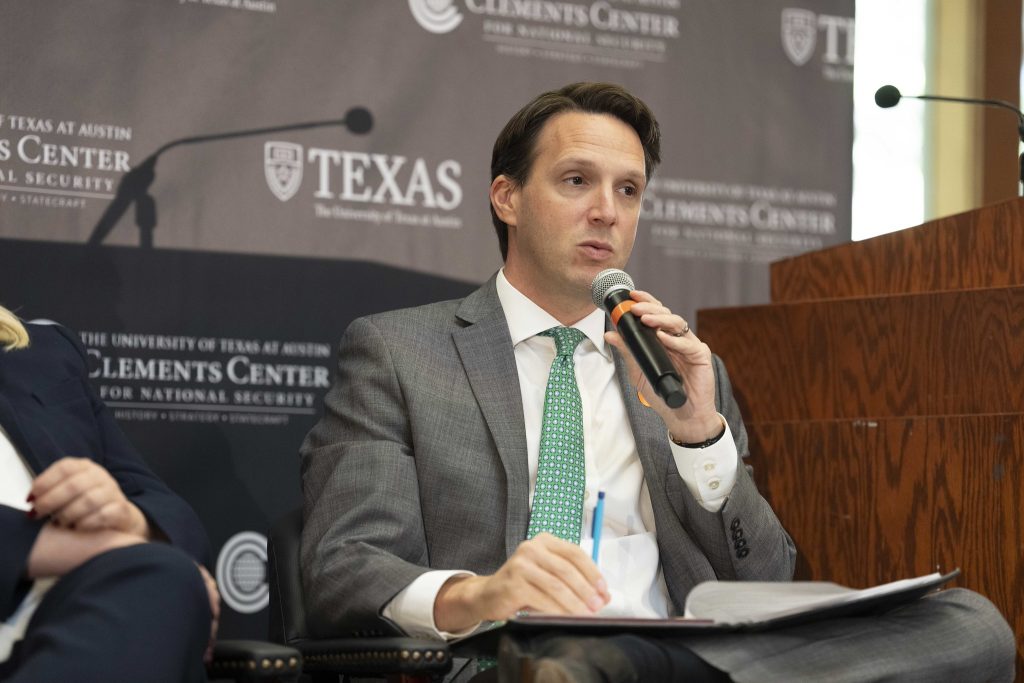
The afternoon panel, “A New Era in the Middle East: Breakthrough or Déjà Vu?,” turned to Saudi Arabia and Iran. Adam Klein, Director of the Strauss Center and Senior Lecturer at Texas Law, moderated a discussion among Cole Bunzel, Assistant Professor at the Clements Center; Matthew Fuhrmann, Dean Rusk Chair and Professor of Security Studies at the LBJ School and Director of the Clements Center’s Nuclear Policy Program; Simone Ledeen, Managing Director of Maven Defense Solutions and former Deputy Assistant Secretary of Defense for Middle East policy; and David Marlowe, Senior Resident Fellow for National Security at the Intelligence Studies Project, Professor of Practice at the LBJ School, and former Deputy Director of Operations at the CIA.
Klein called Saudi Arabia “the most embattled country in the Middle East right now,” with its main airport and Aramco facilities under Houthi attack. Bunzel noted that the Saudi dynasty is older than the United States and has survived rebellion, an uprising in Mecca by messianic rebels in 1979, and waves of terrorism. The current threat is different in kind, he said: missiles and drones aimed at its economy and its Vision 2030 plan. and its Vision 2030 economic plan. Marlowe, who first went to Saudi Arabia as a U.S. soldier during the 1990 Gulf War and later served there with the CIA, described Crown Prince Mohammed bin Salman as a leader managing questions of legitimacy at home, competition with the UAE and Qatar, and an unsettled relationship with Washington.
Ledeen explained why Saudi air defenses have struggled where Israel’s and the UAE’s have not. Riyadh invested in high-end systems such as the Patriot that are poorly suited to cheap drones. “You run out of the missiles a lot faster than they run out of drones,” she said.
Fuhrmann assessed Iran’s nuclear program after the past year’s strikes. The enrichment facilities at Natanz and Fordow and the conversion site at Isfahan were heavily damaged, he said, but weapons-usable material believed to be buried at Isfahan has not been destroyed. Military action has reduced Iran’s capacity to build a weapon while likely increasing its motivation, he said, leaving Washington with “a continuum of options that are a degree of bad.”
Marlowe said Iranian conduct toward the United States has been consistent since 1979 and agreed with Oren that the conflict needs “a clearly definable win.” But regime change imposed from outside, he said, “doesn’t produce a satisfactory result.” The aim should be to create space for change from within.
Klein closed by asking each panelist for one hopeful sign. Marlowe pointed to the crown prince himself: a leader who took power in his early thirties, has already set aside the religious police and allowed women to drive, and may have decades in which to pursue normalization with Israel. Ledeen noted that the campaign against Iranian oil exports has cost China, Iran’s main customer. Small gains, but real ones.
To see photos of this event click here.
To see the video of this event click here.
Click here to listen to a live recording from The University of Texas at Austin, where Aviva Klompas sits down with Dr. Michael Oren, former Israeli Ambassador to the United States, to examine antisemitism through the lens of national security. Also available on Spotify.