



New Fellowship Puts STEM Students at Center of Austin’s Defense Tech Boom
Aug 17, 2026
The Clements Center’s Defense Technology Fellows Program welcomes its first cohort this fall, connecting students in engineering, science and mathematics to defense companies, military commands and research labs that surround the UT campus.
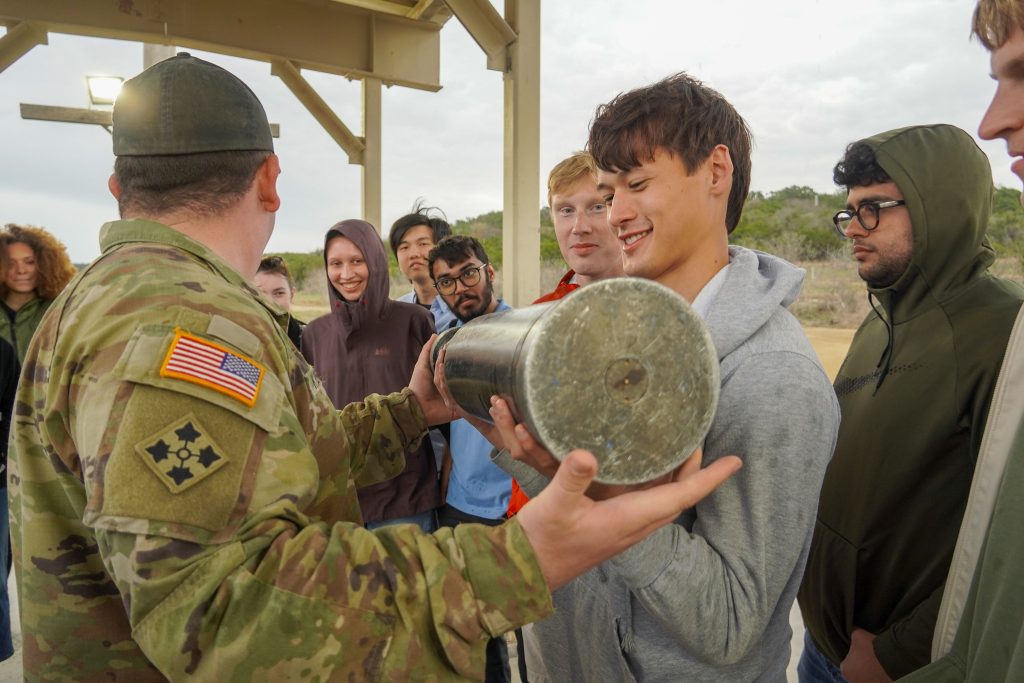
This fall, the Clements Center for National Security welcomes the inaugural class of its Defense Technology Fellows Program, a yearlong undergraduate fellowship built for students in science, technology, engineering and mathematics (STEM) who want to understand the defense world their work may one day shape. A group of 15 undergraduate students make up the first cohort.
The fellowship answers a problem the national security community has discussed for years: a widening talent gap between the people who build advanced technology and the institutions that use it. The most consequential defense questions increasingly center on artificial intelligence, autonomy, nuclear power and robotics, yet the students mastering those subjects rarely encounter national security as a field of study. That gap is what the Clements Center hopes to address with its new Defense Technology Fellows Program.
“The Clements Center has historically attracted history, political science and government students to its programs. STEM students have parallel but different interests, and we weren’t always reaching them,” said Dirk Ringgenberg, professor of practice at the Clements Center and the faculty lead for the new program. “They’re building things that may or may not touch defense, and they often don’t know which. They’re fascinated by what they don’t know, and for a lot of them, that’s the entire defense industry.”
For Paul Edgar, executive director of the Clements Center, the program extends a long-standing mission to a new audience.
“New technology and national security are a perennially challenging combination, even before the invention of bronze, the domestication of the horse, and their employment in war,” Edgar said. “Today, the challenge is staggering and consequential. It is a challenge that cannot be met by engineers or strategists working in isolation. This program brings those worlds together for our young, bright minds; it familiarizes them with the defense tech ecosystem before they enter it. There is no better place to do that than The University of Texas at Austin. We are giving talented students a grounding in technology, current events, policy, business, history and strategy that will serve them, and the country, for the rest of their lives.”
The Right Place
A strength of this program is in its location and the access it provides. “Austin holds one of the densest concentrations of defense innovation in the country and gives us something very unique,” Ringgenberg said. “Austin brings together the state government, the state’s flagship public research university, a dense cluster of defense and dual-use companies, and a four-star Army command — the U.S. Army Transformation and Training Command (T2COM) — all within roughly a 5-mile radius.”
That concentration is growing on campus as well: UT Austin is hiring more than 20 new scholars in national security-related fields beginning this fall, a signal of how central these questions have become to the institution. Beyond campus, venture funding for Austin-area startups reached a record $7.19 billion in 2025, according to Crunchbase. Among the year’s largest rounds was a $600 million infusion for Saronic Technologies, an Austin company that builds autonomous naval vessels.
The program is designed to use that access. In addition to guest lectures from practitioners, including military officers, policymakers, industry leaders and government researchers, fellows will visit sites directly. Plans for the fall semester include visits to the nuclear research reactor at the J.J. Pickle Research Campus, the Texas Robotics facility in UT’s Anna Hiss Gymnasium, and Camp Mabry. A spring trip will take students to two of the three laboratories in the Department of Energy’s National Nuclear Security Administration: Sandia National Laboratories and Los Alamos National Laboratory.
Although the fellowship is built primarily for STEM students, it is open to undergraduates in other majors who can demonstrate an interest in the program and relevant professional experience through an internship or prior job experience.
Applications for the 2027-28 cohort will open during Spring 2027. More information is available on the Defense Technology Fellows Program page.
History First, Then Technology
Ringgenberg, a historian of military technology and a retired combat leader, frames the fellowship around a single idea: that technology means little until people decide how to use it. He encourages students to see technology through the broad lens of its historical and societal impacts.
“People hear ‘technology,’ and they think computers, microchips, the latest thing on a screen,” Ringgenberg said. “But ask a hundred historians to define technology, and you’ll get a hundred answers. For example, one of the most consequential military technologies in American history was the smallpox inoculation.”
He points to the Revolutionary War, when smallpox was killing more of George Washington’s soldiers than the British were. Inoculation at the time was risky and deeply controversial, and it meant deliberately infecting healthy troops. A botched program could have crippled the army it was meant to save. Washington ordered the mass inoculation of the Continental Army anyway, in secret, making it one of the first large-scale immunization efforts in military history.
“That decision saved the army, and it may have saved the Revolution. It wasn’t a weapon, but it was absolutely defensive technology,” Ringgenberg said. “The power of any tool comes from the ideas and the institutions built around it. No technology is disruptive on its own. It has to be incorporated into an operational approach. That’s what I want students to understand, because that understanding is the whole game.”
The same logic runs through military history. Ringgenberg offers the bayonet as an example: a simple blade fixed to a musket during the 1600s. On its own, in a single soldier’s hands, it does little. “But combine it with drill, discipline, and a shared idea about how to use it,” he said, “and massed infantry with bayonets becomes something that can shock an enemy into flight.”
That shock is the point. By the numbers, bayonets caused relatively few casualties compared with artillery or disease; their real power was the dread they produced. Enemies often broke and ran before the lines ever met. The effect lived in the mind, and it came from the tactics and reputation built around the weapon rather than the weapon itself. Ringgenberg sees the same pattern in today’s drones, whose psychological weight on a battlefield can surpass the physical damage they do.
“How does a tool come to mean that much?” he said. “That’s what I want students to see, that nuclear, AI, drones, whatever it is, only matter once they’re built into an idea about how to use them.”
Each month, the students will take up a new theme, with nuclear energy, robotics and artificial intelligence leading the fall agenda. Fellows will present their own fields of study and explain how each connects to defense, while Ringgenberg and other guest speakers will offer a briefing on developments around the world.
“The students are the drivers,” Ringgenberg said. “Many of them already know where their own gaps are, whether it’s AI, robotics or nuclear, and they tell us what they want to learn.”
The broader aim, he said, runs deeper than any single technology. The goal is for students to see today’s debates about AI and autonomy as the latest chapter in a long story rather than a clean break from it. “I’m not an AI expert, but I’m a historian, and I know examples of technology that follow the same path,” he said.
Guidance from the Field
Joining Ringgenberg in leading the program is retired Maj. Gen. Jeannie Leavitt, a Clements Center Distinguished National Security Fellow. A UT graduate in aerospace engineering, Leavitt became the first female fighter pilot in the Air Force in 1993, after the Department of Defense lifted its combat exclusion policy for women. She went on to command a combat fighter wing and serve as principal military assistant to two secretaries of defense.
Leavitt’s connections across the national laboratories and the defense industry will open doors for the fellows, and her own path — from an engineering degree to senior military command — shows them a career they might not have known existed.
That trajectory, from technical training to a role in national defense, points to the deeper purpose behind the fellowship. Ringgenberg sees the talent gap the program was built to address as a recurring feature of U.S. history, not a new problem. During World War I, he explained, the Army faced a shortage of soldiers who understood the era’s most advanced communications technology, so it commissioned executives from Bell Telephone directly as officers to build and run its telephone and telegraph networks. The military needed expertise it could not grow quickly enough on its own, and it brought in that expertise from industry.
He expects the same pattern to define the decades ahead, as the armed forces lean on civilian specialists in artificial intelligence, robotics and other fields that are difficult to replicate in uniform. For the fellows, it reframes what a national security career can look like.
“Our future students may never put on a uniform, but many may be part of the military at some point in their careers,” he said. “The technology gap in the armed forces is going to be closed by civilian experts. There’s no way around that right now.”
Fellows will earn a certificate upon completing the fellowship, but Ringgenberg is after something less tangible. Students who would otherwise stay inside their own departments, including engineers, physicists and mathematicians, will work side by side, learning how each of their fields touches national security. The Clements Center is known for turning that kind of interdisciplinary contact into lifelong friendships, and Ringgenberg wants the same for this cohort: not just a credential, but a community. “They become part of a group of people they’d never have met otherwise.”