

Revisiting “Cold War 2.0?”: Insights for Today’s National Security
Apr 30, 2025
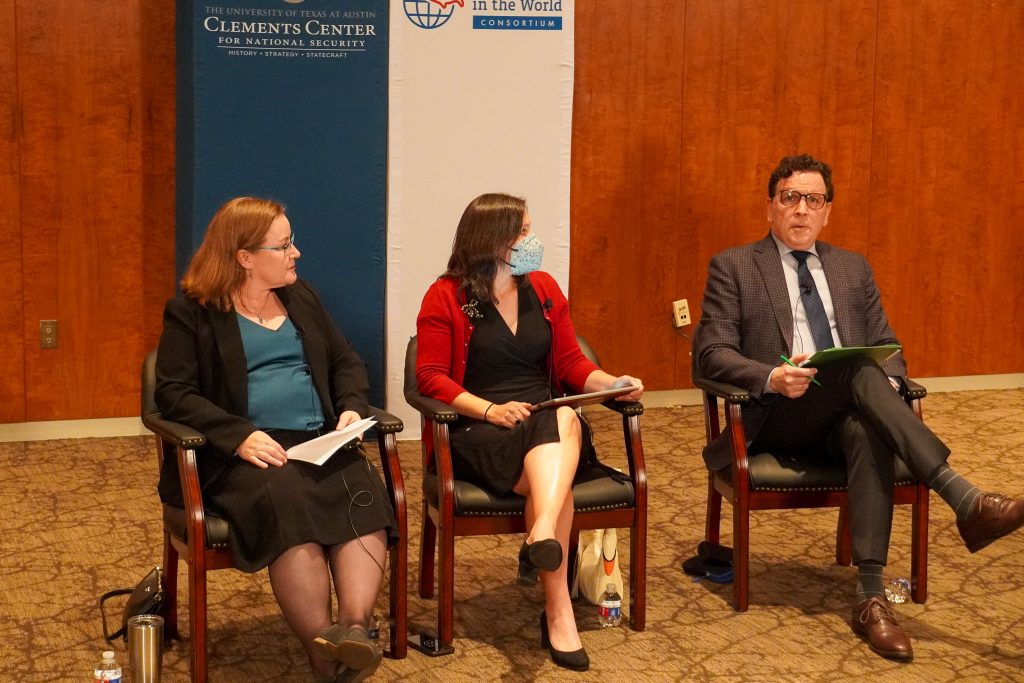
On April 24th and 25th, the Clements Center for National Security, the UT-Austin Department of History, and the America in the World Consortium hosted the conference “Cold War 2.0? Power and Prudence: Lessons of the Cold War for the 21st Century” in Bass Lecture Hall at the LBJ School for Public Affairs.
As great power competition grows, the conference explored how Cold War-era lessons in military strategy, diplomacy, and economic policy can inform current geopolitical challenges. Featuring top historians and national security experts, the discussions aimed to provide insights on shaping U.S. global leadership in today’s complex world.
Paul Edgar, Clements Center Associate Director, opened the conference by highlighting the importance of applied history using the past to shape present and future decisions. Executive Director, Vice Admiral (Ret.) Joe Maguire, echoed this sentiment, highlighting the critical role of understanding Cold War dynamics in addressing today’s global challenges. Their remarks set the stage for a series of discussions that aimed to extract actionable insights from the past, while recognizing the significant changes since the Cold War-era.

Melvyn Leffler (University of Virginia) delivered the opening keynote on “Drawing Analogies, Extrapolating Lessons: Reflections on the Cold War,” emphasizing that while the Cold War offers important lessons, especially on diplomacy, alliances, and the balance of state-market power, drawing direct analogies to today is often misleading. “When pondering the economic rivalry between the United States and China, today the Cold War teaches how important is the State’s role in providing incentives to remain ahead in technologies that shape, military capabilities and business competitiveness,” says Leffler.
The first session concluded with a panel discussion, “Military Power: Lessons from the Cold War” featured Tommy Jamison (Naval Postgraduate School), Simon Miles (Duke University), and Stephen Wertheim (Carnegie Endowment for International Peace). The panel was moderated by Eliot Cohen (CSIS; Johns Hopkins University). The conversation underscored the role of technology advancements, human factors in military readiness, and a comprehensive approach to global competition.
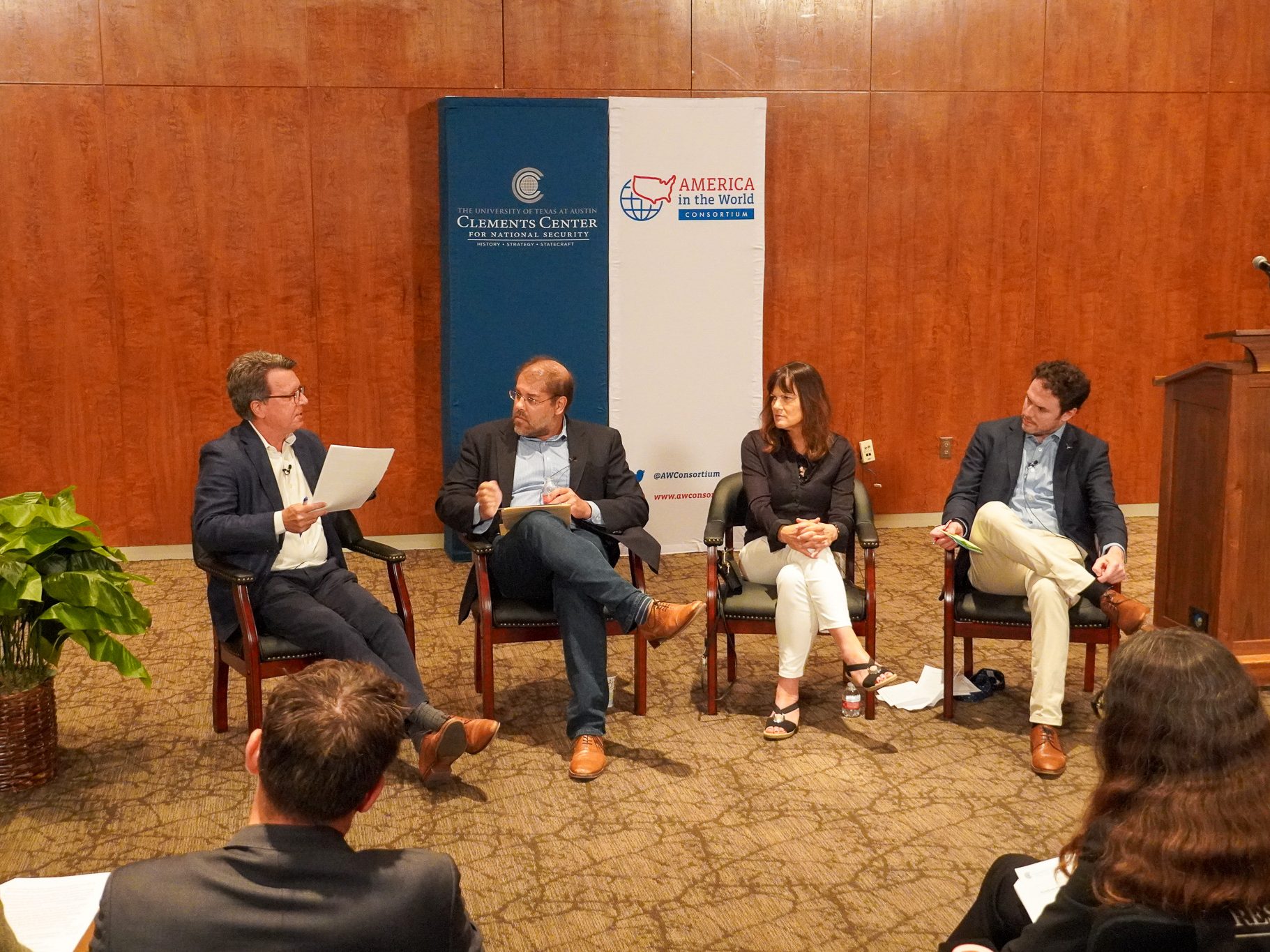
The second session kicked off with a panel titled “Defining Vital Interests, Resolving Priorities, and Assessing Tradeoffs: Geostrategy, Economics, Human Rights, Democracy Promotion, and Development,” with Barbara Keys (Durham University), Charlie Laderman (King’s College London; University of Florida), and Jeremi Suri (UT-Austin). The discussion was moderated by Mark Lawrence (UT-Austin). Lawrence framed the conversation around three tensions in U.S. foreign policy: hard vs. soft power, addressing threats vs. asserting moral leadership, and unilateralism vs. alliance-building. Panelists challenged the “Cold War 2.0” framing, emphasizing the decline of U.S. influence, the retreat of human rights in diplomacy, and shifting global priorities. They emphasized foreign aid as a cost-effective tool and stressed the need for strategic compromise.
The next panel “Economic Systems and Their Implications” featured Daniel Sargent (University of California, Berkeley), Joseph Torigian (Stanford’s Hoover History Lab; American University) and was moderated by Bob Zoellick (Harvard University). The panel explored the intersection of history, geopolitics, and economics in understanding current global challenges. The panel explored how historical context can illuminate the political and economic challenges facing global powers today, particularly in authoritarian systems like China. They emphasized the importance of institutional adaptability, public support, and financial credibility in maintaining long-term stability and global influence.
Session three kicked off with a keynote discussion by Michael Kimmage (Catholic University) on “The Soul of “The West” in the 20th and 21st Century.” His remarks addressed the shifting, complex, and often elusive concept of ‘the West,’ tracing its evolution across both historical and contemporary contexts. Kimmage pinpointed the 2008 financial crisis as a key turning point, weakening the Western model and fostering alternative international systems led by China and Russia and noted the rise of “middle powers” like Turkey and India, which further diminished the West’s dominance.

Kimmage’s keynote was followed by a panel titled “Negotiating with Adversaries, Negotiating with Allies: Diplomacy in the Cold War,” with Jeremy Friedman (Harvard University), Robert Hutchings (Princeton University; University of Texas), Thomas Schwartz (Vanderbilt University), and Annika A. Culver (Florida State University; U.S.-Japan Network for the Future). The panel was moderated by Major General (Ret.) Jeannie Leavitt (UT-Austin) and explored how Cold War diplomacy was shaped by both geopolitical strategy and cultural understanding, emphasizing that successful international engagement depended on compromise, empathy, and clear leadership.
The final panel of the conference was titled “The Cold War in and through U.S. Domestic Politics” with panelists Darren Dochuk (University of Notre Dame) and Lauren Turek (Trinity University), and was moderated by Kate Weaver (UT-Austin). Both Dochuk and Turek explored how religion continues to shape U.S. foreign policy, though in markedly different ways than during the Cold War. Turek emphasized that while states are driven by interests, “they explain and pursue those interests through their cultural values, religious beliefs, and ideological frameworks.”
Missed the event? Watch the full recordings here.


View all photos from the conference here.