


Clements Center Wraps Eleventh Annual London May Term on the Transatlantic Alliance
Jun 30, 2026
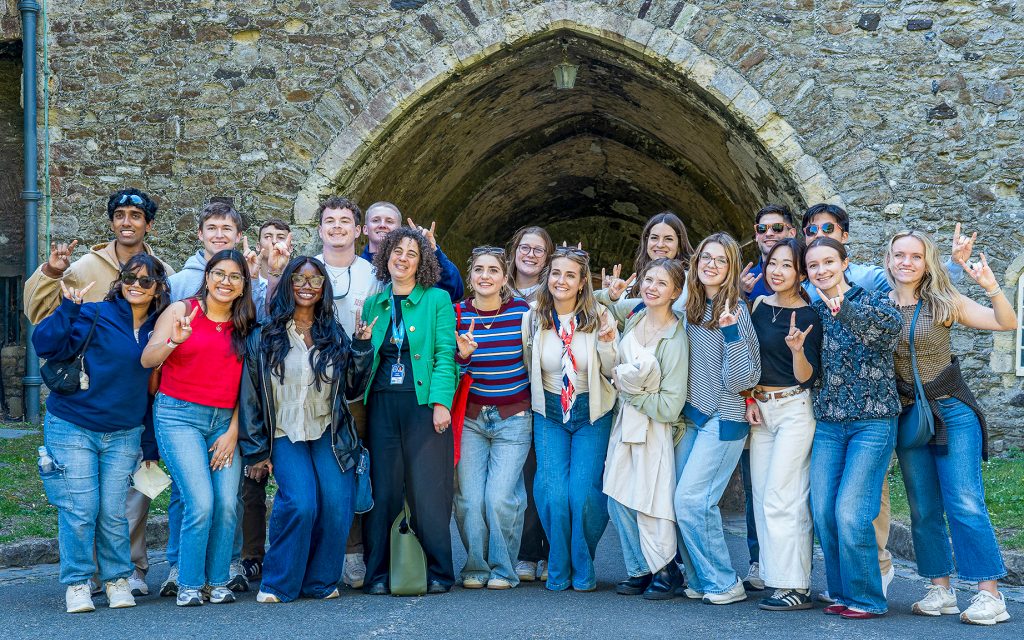
For four weeks, UT Austin students studied the transatlantic alliance in the lecture halls, the war rooms, and on the beaches of Normandy.
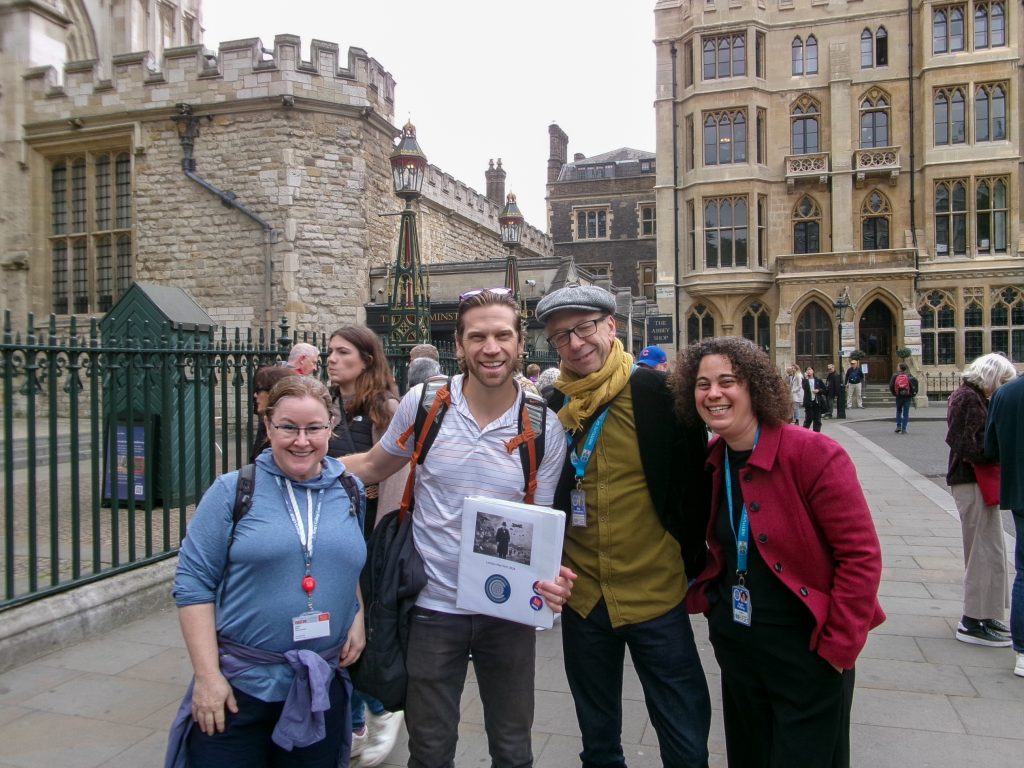
From a seminar room at King’s College London to the chalk tunnels beneath Dover Castle and the bluff above Omaha Beach, 20 UT Austin students spent four weeks this spring tracing the transatlantic alliance through the places that made it. The program—The U.S. and U.K.: Past, Present, and Future of the Transatlantic Alliance—is built on the premise of the “special relationship” that has existed between the two countries and its evolution over time.
Academic home base was the War Studies Department at King’s College London, one of the leading centers for the study of strategy and international security in the world. The curriculum traced the alliance from its contested origins to its uncertain present: how Britain became a global power and how empire shaped the international order it claimed to uphold; how the Anglo-American relationship was forged and strained across the First World War; how the Second World War shifted global power decisively from London to Washington; and how the Cold War tested the alliance.
Sessions on the contemporary alliance covered foreign aid as a tool of statecraft and the structural questions now facing transatlantic security, with a standout conversation led by Sir Mark Lyall Grant, former UK Permanent Representative to the United Nations, analyzing just how special the “special relationship” remains today. Other sessions focused on the United Nations and whether it can still do what it was designed to do, post-Caliphate jihadism and Islamic extremism in the West, Russia and China, Indo-Pacific security, and how small states strategically position themselves in a system that can be dominated by larger powers. A wargame titled “Escalation in the East,” a workshop on Iran with former UK Special Envoy Sir Simon Gass, and a concluding workshop on world order gave students room to apply what they had been learning. Students also attended the London Defence Conference Future Leaders’ Day, where they had the opportunity to meet and engage with current and emerging leaders across the defense and national security community.
Part of what makes the London program distinctive is its commitment to experiential learning—combining classroom instruction with simulations, debates, and visits to historically significant sites that bring the curriculum to life. Classroom and field reinforce each other throughout. At Dover Castle, students descended into the chalk tunnels where Vice Admiral Bertram Ramsay coordinated the evacuation of more than 338,000 Allied troops from Dunkirk in nine days in 1940—a tangible counterpart to the sessions on wartime strategy. The Churchill War Rooms put faces and places to the wartime leadership students had been analyzing in seminar. A visit to Bletchley Park, where British codebreakers cracked German Enigma, deepened the intelligence and strategy discussions. A weekend in Cambridge, one of the seats of British academic excellence, rounded out the field program.
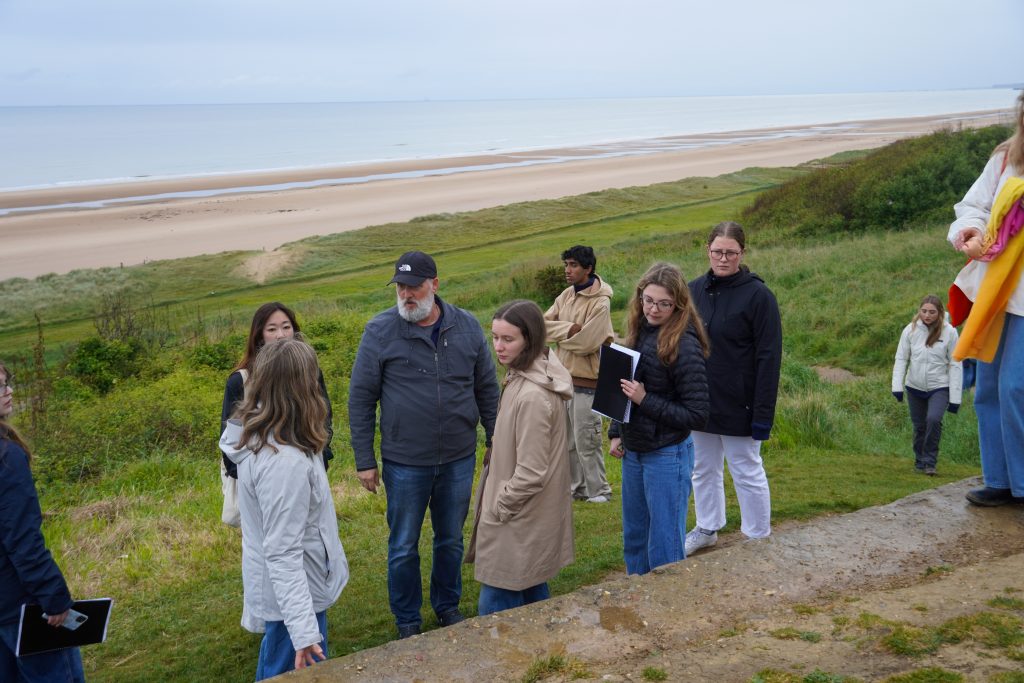
Normandy, one of the program’s highlights, saw the addition of General Robert B. Neller, the 37th Commandant of the U.S. Marine Corps. General Neller’s presence added a singular opportunity for mentorship and tutelage from a longtime public servant dedicated to developing the next generation of national security leaders. Over two days, the group traced the geography of the D-Day landings, from the paratrooper drop zones at Sainte-Mère-Église to Utah Beach and the clifftop battery at Pointe du Hoc that Army Rangers scaled under fire on the morning of June 6, 1944. The second day moved from Omaha Beach to the artificial Mulberry harbor at Arromanches and the German guns still standing in their casemates at the Batterie de Longues-sur-Mer, where students delivered presentations on coastal defense and the Atlantic Wall, before ending at Pegasus Bridge.
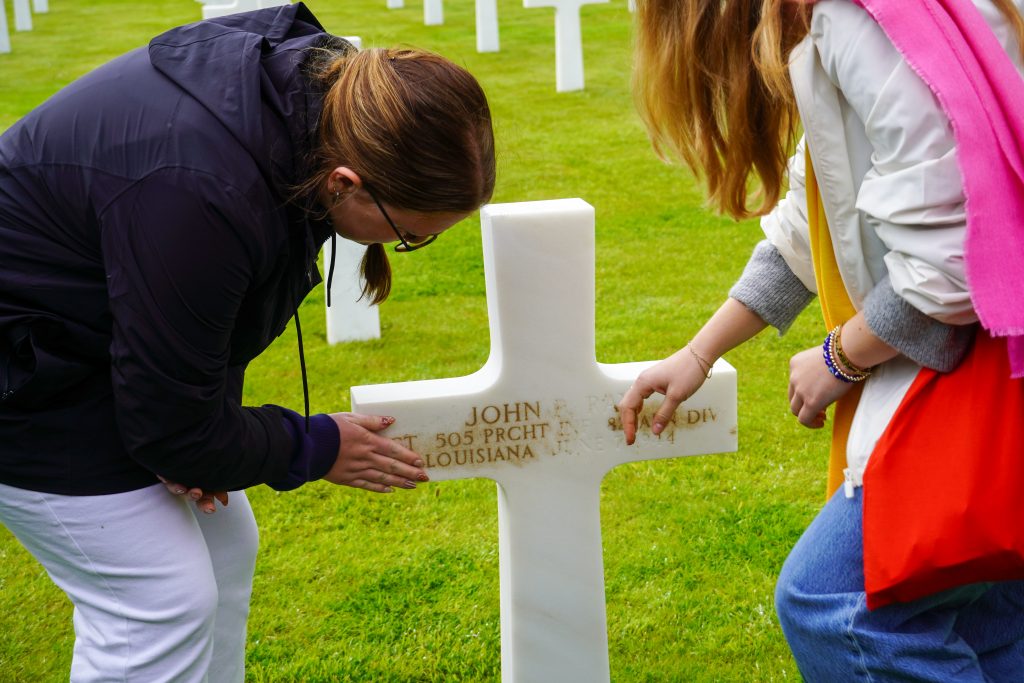
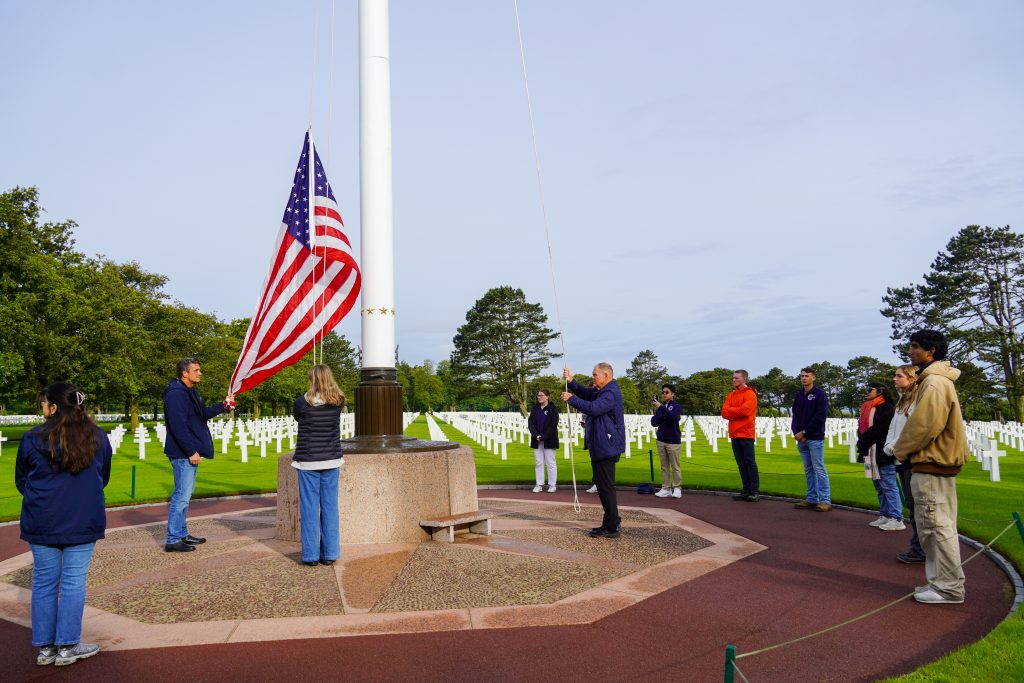
The visit to the Normandy American Cemetery at Colleville-sur-Mer was one of the most memorable moments of the program. Each morning before the grounds open to the public, the American Battle Monuments Commission conducts a formal flag-raising ceremony that the students were invited to lead, and later in the day they took part in the cemetery’s sand ceremony, a quiet act of remembrance that makes each grave legible again, one name at a time.
Marina Guandolo, a public relations major, said the Normandy visit stayed with her long after the program ended. “No amount of classroom lessons could compare to standing on the beaches of Normandy,” she said. “It is hard to reconcile the beauty of Omaha Beach today with the violence that once took place there. It was one of many experiences on the May Term that showed me how essential it is to encounter history in person because some lessons cannot be fully understood through books or lectures. They must be felt in the places where they happened.”
The program closed in London with group debates on the future of American grand strategy and a farewell dinner.
Check out the video recap and the photo album for a closer look at the 2026 London May Term.
Applications for the 2027 London May Term will open in early September 2026. Students interested in the program can learn more on the Clements Center website.