


Scholars, Diplomats, and Intelligence Officers Bring Global Perspective to Clements Center’s Spring Speaker Series
May 05, 2026
The Clements Center and its partners hosted six talks, lectures, and panels this spring on questions at the center of national security and international affairs, from Venezuela’s democratic transition to the front lines of Russian aggression to the future of AI-powered intelligence.
Across seven events, the spring speaker series covered five continents and a century of military and political history, with speakers drawn from diplomacy, intelligence, the academy, and policy research.
Venezuela After Maduro: On-the-Ground Perspectives on Democratic Transition
The semester opened on January 15 with Venezuela After Maduro: On-the-Ground Perspectives on Democratic Transition, hosted at the UT School of Law with the Bech-Loughlin First Amendment Center, the Strauss Center, the School of Civic Leadership, and the Civitas Institute. Juan Miguel Matheus, Bowden Resident Fellow at Texas Law and a former member of Venezuela’s opposition National Assembly; Diego Zambrano, Associate Dean for Global Programs at Stanford Law; and Kurt Weyland, professor of government at UT Austin, examined the constitutional consequences of Nicolás Maduro’s removal and what genuine democratization would require from the opposition.
Yemen and the Houthis: Unfinished Business

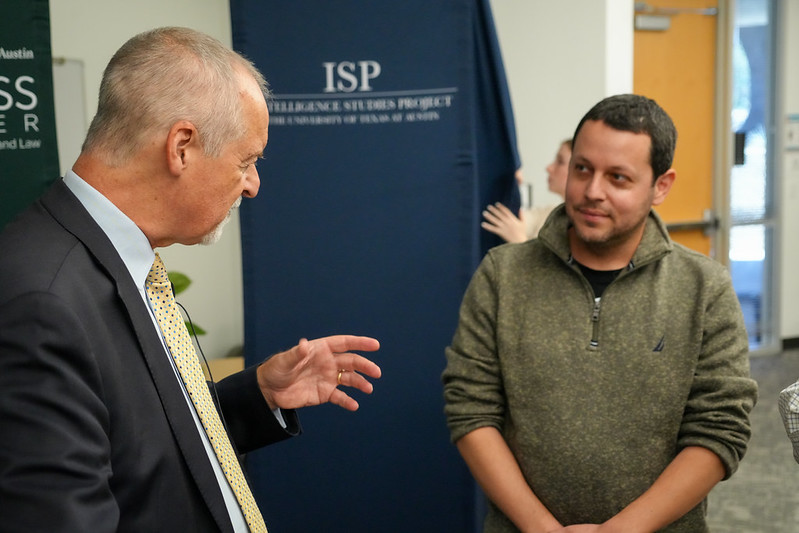

On February 16, Ambassador (Ret.) Edmund Fitton-Brown joined the Intelligence Studies Project’s Hot Spot Briefing series at the LBJ School for Yemen and the Houthis: Unfinished Business. Fitton-Brown, former UK Ambassador to Yemen and later Coordinator of the UN’s Analytical Support and Sanctions Monitoring Team, traced the history of the Houthi movement and the regional dynamics shaping Yemen’s trajectory. Additional photos are available in this Flickr album.
Japan: America’s Canary in the Chinese Coal Mine
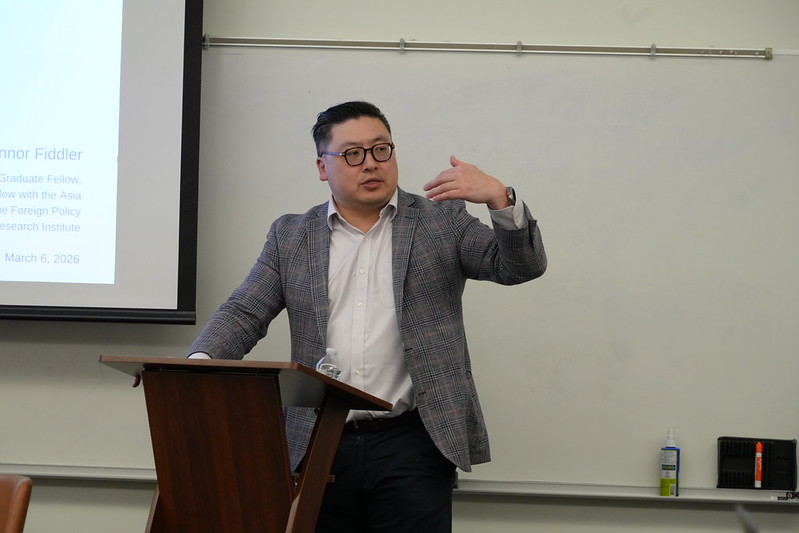

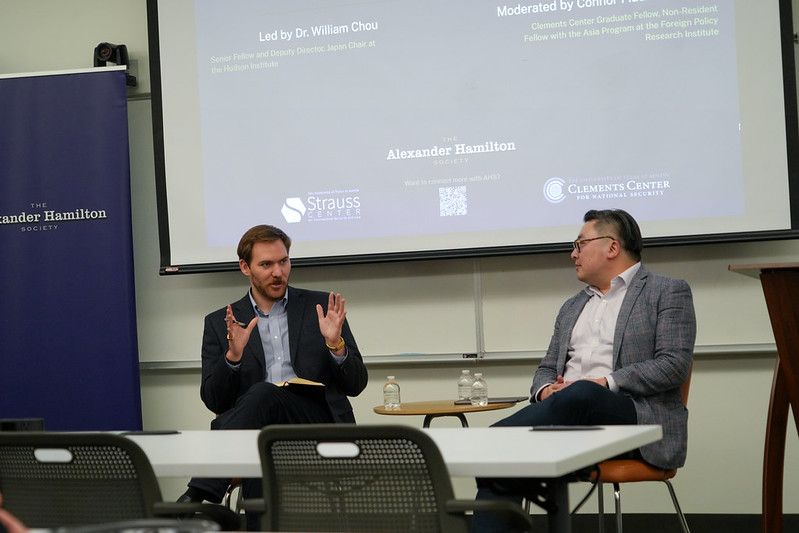
On March 6, the Clements Center and the Alexander Hamilton Society’s UT chapter hosted William Chou, Senior Fellow and Deputy Director of the Japan Chair at the Hudson Institute, for Japan: America’s Canary in the Chinese Coal Mine. Chou examined Japan’s strategic position as Chinese pressure on the region intensifies, and what American policymakers can learn from Tokyo’s experience. More photos are available in this Flickr album.
Intelligence and OSINT in the Age of AI


On March 9, the Intelligence Studies Project launched its new Off the Wire series with Intelligence and OSINT in the Age of AI, featuring Randy Nixon, former Director of the CIA’s Open Source Enterprise. Nixon, who founded the CIA’s Office of Advanced Analytics and was among the first senior intelligence officials to integrate AI into open-source work at scale, addressed how AI is changing what open-source intelligence can do and what it cannot replace. More photos are available in this Flickr album.
From Chechnya to Ukraine: Resisting Russian Aggression
The Hot Spot Briefing series returned on March 25 with From Chechnya to Ukraine: Resisting Russian Aggression, featuring Michael Dennis, Associate Professor of Practice at the LBJ School and ISP Fellow. Drawing on his work as a U.S. Intelligence Community analyst and as an aid worker in Chechnya during the Second Russo-Chechen War, Dennis traced the arc of Russian military aggression and examined how the war in Ukraine is reshaping the Chechen diaspora.
Egypt’s Balancing Act: Regional Influence and Domestic Realities


The semester’s final speaker event, on April 16, was Egypt’s Balancing Act: Regional Influence and Domestic Realities, co-hosted with the Strauss Center and the Intelligence Studies Project. Mariam Wahba, research analyst at the Foundation for Defense of Democracies, examined how Cairo manages its relationships with major powers while navigating mounting domestic pressures on governance and minority rights. Photos are available in this photo album.